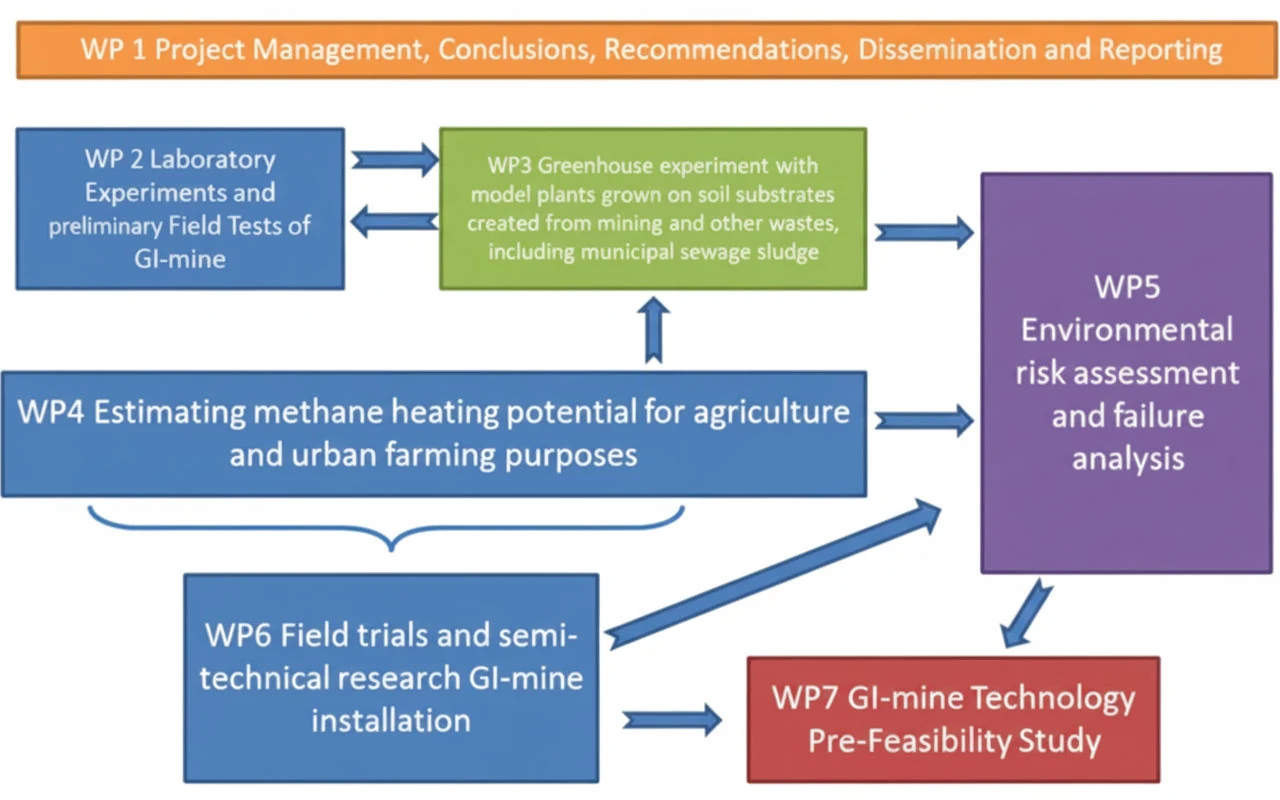
General GI-mine project workflowText description of the diagram
WP1 Project Management, Conclusions, Recommendations, Dissemination and Reporting – runs across the whole project.
WP2 Laboratory Experiments and preliminary Field Tests of GI-mine – exchanges results with WP3.
WP3 Greenhouse experiment with model plants grown on soil substrates created from mining and other wastes, including municipal sewage sludge.
WP4 Estimating methane heating potential for agriculture and urban farming purposes – feeds WP3 and WP5.
WP5 Environmental risk assessment and failure analysis – receives results from WP3, WP4 and WP6.
WP6 Field trials and semi-technical research GI-mine installation – builds on WP2–WP4.
WP7 GI-mine Technology Pre-Feasibility Study – based on WP5 and WP6.
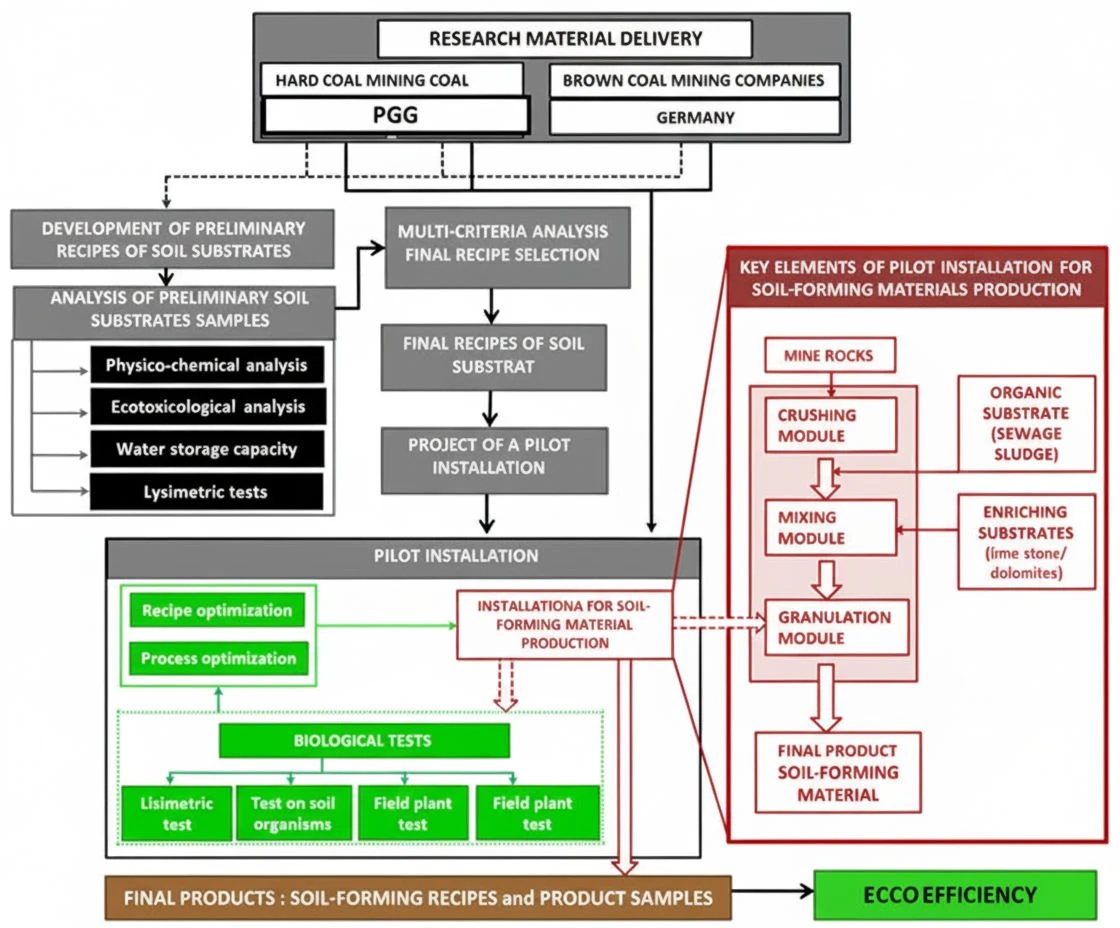
GI-mine – solid mine wastes research installation flow chartText description of the diagram
Research material delivery from hard coal mining (PGG) and brown coal mining companies (Germany).
Development of preliminary recipes of soil substrates and analysis of the samples: physico-chemical analysis, ecotoxicological analysis, water storage capacity, lysimetric tests.
Multi-criteria analysis and final recipe selection, final recipes of soil substrate, design of a pilot installation.
Pilot installation for soil-forming material production: mine rocks go through the crushing module, the mixing module (with organic substrate – sewage sludge – and enriching substrates – limestone/dolomites) and the granulation module, giving the final product: soil-forming material.
Optimisation and biological tests of the product: recipe and process optimisation, lysimetric test, test on soil organisms, field plant tests.
Final products: soil-forming recipes and product samples, leading to eco-efficiency.
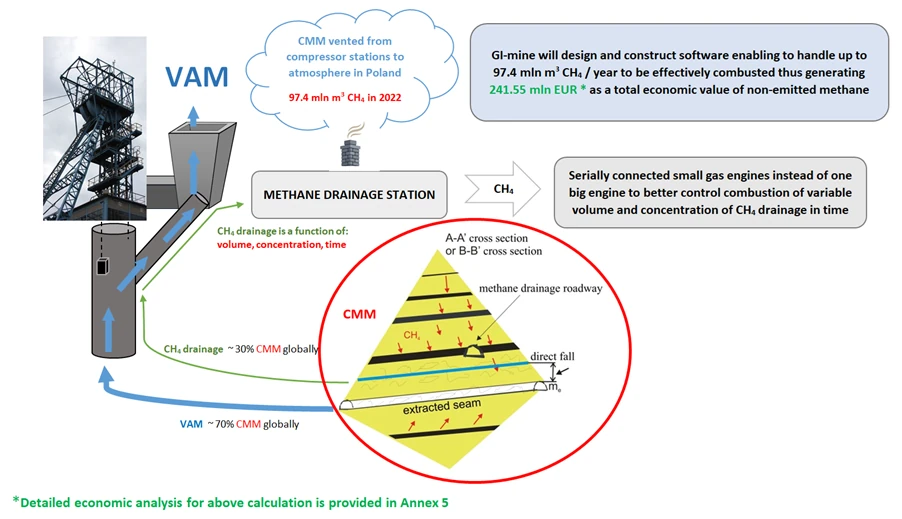
GI-mine methane applicationText description of the diagram
Coal mine methane (CMM) leaves a mine as ventilation air methane (VAM, about 70% of CMM globally) and through methane drainage (about 30% of CMM globally).
Drained methane goes to a methane drainage station; its amount depends on volume, concentration and time.
In 2022, 97.4 million m³ of CH₄ were vented from compressor stations to the atmosphere in Poland.
GI-mine will design and construct software enabling up to 97.4 million m³ CH₄ per year to be effectively combusted, generating 241.55 million EUR as a total economic value of non-emitted methane (detailed economic analysis in Annex 5 of the proposal).
Serially connected small gas engines are used instead of one big engine to better control combustion of the variable volume and concentration of drained CH₄ over time.